


CR seals
Weather-resistant, flame-retardant, and versatile
CR (chloroprene rubber) is a versatile elastomer sealing material that is characterized in particular by its good resistance to ozone, weathering, and aging. In addition, CR seals offer excellent mechanical properties, flame resistance, and resistance to water, many refrigerants, and diluted acids. Because of these properties, CR seals are used in numerous industrial applications—particularly in the automotive, HVAC, medical, and marine industries.
We at Rehm Dichtungen Ehlers GmbH process a wide variety of CR sealing materials to produce custom flat and flange gaskets. From standard solutions to custom-made products based on drawings, we manufacture your desired CR gaskets precisely according to your requirements. Whether it’s a prototype, a small production run, or a large-scale production run—at Rehm Dichtungen, you benefit from our many years of experience and the right manufacturing processes for every batch size and dimension.
What are CR seals?
CR stands for chloroprene rubber, a synthetic rubber and belongs to the elastomers of the R group, which are characterised by an unsaturated hydrocarbon chain. Probably the best-known trade name is Neoprene® In addition, the material is also traded as Baypren®.
CR Materials Available from Rehm Dichtungen
We obtain most of our sealing material from the manufacturer Semperit in the form of rolls and sheets. Here we divide the material qualities into three ranges that are suitable for different applications.
Semperit Quality from CR Seals
N9581 CR/SBR
Technical data sheet:
Properties:
| Hardness [Shore A] | ISO 7619-1 | 65 +-5 |
| Density [g/cm³] | ISO 1183 | Approx. 1.40 |
| Tensile strength [N/mm²] | ISO 37-S2 | 6 |
| Elongation at break [%] | ISO 37-S2 | 200 |
Approvals and certifications:
- Corresponds to WDK guideline 2201
- SVHC-free
N572 CR
Semperit CR N572 is a sulphur-cured elastomer with good weather resistance and resistance to most aliphatic oils. This material is self-extinguishing according to ISO 4859-2:2017 (O2 index up to max. 30%).
Technical data sheet:
Properties:
| Hardness [Shore A] | ISO 7619-1 | 70 +-5 |
| Density [g/cm³] | ISO 1183 | Approx. 1.55 |
| Tensile strength [N/mm²] | ISO 37-S2 | 7 |
| Elongation at break [%] | ISO 37-S2 | 300 |
Import qualities
CR/SBR 65 Shore
Technical data sheet:
Properties:
| Hardness [Shore A] | ISO 7619-1 | 65 +-10 |
| Density [g/cm³] | ISO 1183 | Approx. 1.4 |
| Tensile strength [N/mm²] | ISO 37-S2 | 4 |
| Elongation at break [%] | ISO 37-S2 | 250 |
CR/SBR 65 Shore with insert
Technical data sheet:
Properties:
| Hardness [Shore A] | ISO 7619-1 | 65 +-10 |
| Density [g/cm³] | ISO 1183 | Approx. 1.4 |
| Tensile strength [N/mm²] | ISO 37-S2 | 4 |
| Elongation at break [%] | ISO 37-S2 | 250 |
CR/SBR light 65 Shore
Technical data sheet:
Properties:
| Hardness [Shore A] | ISO 7619-1 | 65 +-10 |
| Density [g/cm³] | ISO 1183 | Approx. 1.5 |
| Tensile strength [N/mm²] | ISO 37-S2 | 5 |
| Elongation at break [%] | ISO 37-S2 | 300 |
The properties of CR as a sealing material
Chloroprene is produced by polymerising 2-chloro-1,3-butadiene. During the process, acid is added to the resulting dispersion, which is then cooled and dried.
The chlorine atoms in the material are chemically inert, which makes the rubber stable. Furthermore, vulcanized chloroprene exhibits good mechanical and chemical properties.
The material is resistant to embrittlement, ozone, and weathering. The synthetic rubber exhibits good resistance to swelling in mineral oils with an aniline point, in fats, many refrigerants, and in water. In mineral oils and low-molecular-weight aliphatic hydrocarbons, CR exhibits moderate resistance to swelling. In aromatic compounds, the material swells significantly. Chloroprene is temperature-resistant in the range of -20° C to +120° C. Specific specifications vary depending on the compound formulation.
Do you have any questions or would you like some free advice?
Feel free to contact us - we will help you! Our dedicated team is always on hand to answer your questions.

The advantages of CR at a glance
Chloroprene is characterised by a number of properties that make the material suitable for many applications. It is:
- Resistant to: Embrittlement, ozone and weathering influences
- Good swelling resistance to: mineral, vegetable and animal fats as well as mineral oils with a high aniline point, many refrigerants and water
- strongly swelling in: Aromatics such as benzene, esters, ketones and chlorinated hydrocarbons.
- Resistant to: dilute acids and salt solutions
- flame-retardant
Furthermore, the elastomer has very good dynamic properties. The electrical insulating properties of polychloroprene are worse than those of NR, which is due to the polarity. Certain fillers increase the insulating properties. CR can therefore be used in the low-voltage range.
The sealing material cannot be cross-linked with sulphur, has only limited oil resistance and is not resistant to fuels or aromatic oils.
CR Resilience at a glance
| Material designation | Ozone and weather resistance | Oil and petrol resistance | Acid resistance | Strong bases | Wear resistance |
|---|---|---|---|---|---|
| Semperit N 9581 | conditionally stable | not durable | conditionally stable | conditionally stable | Not suitable |
Areas of application for CR seals
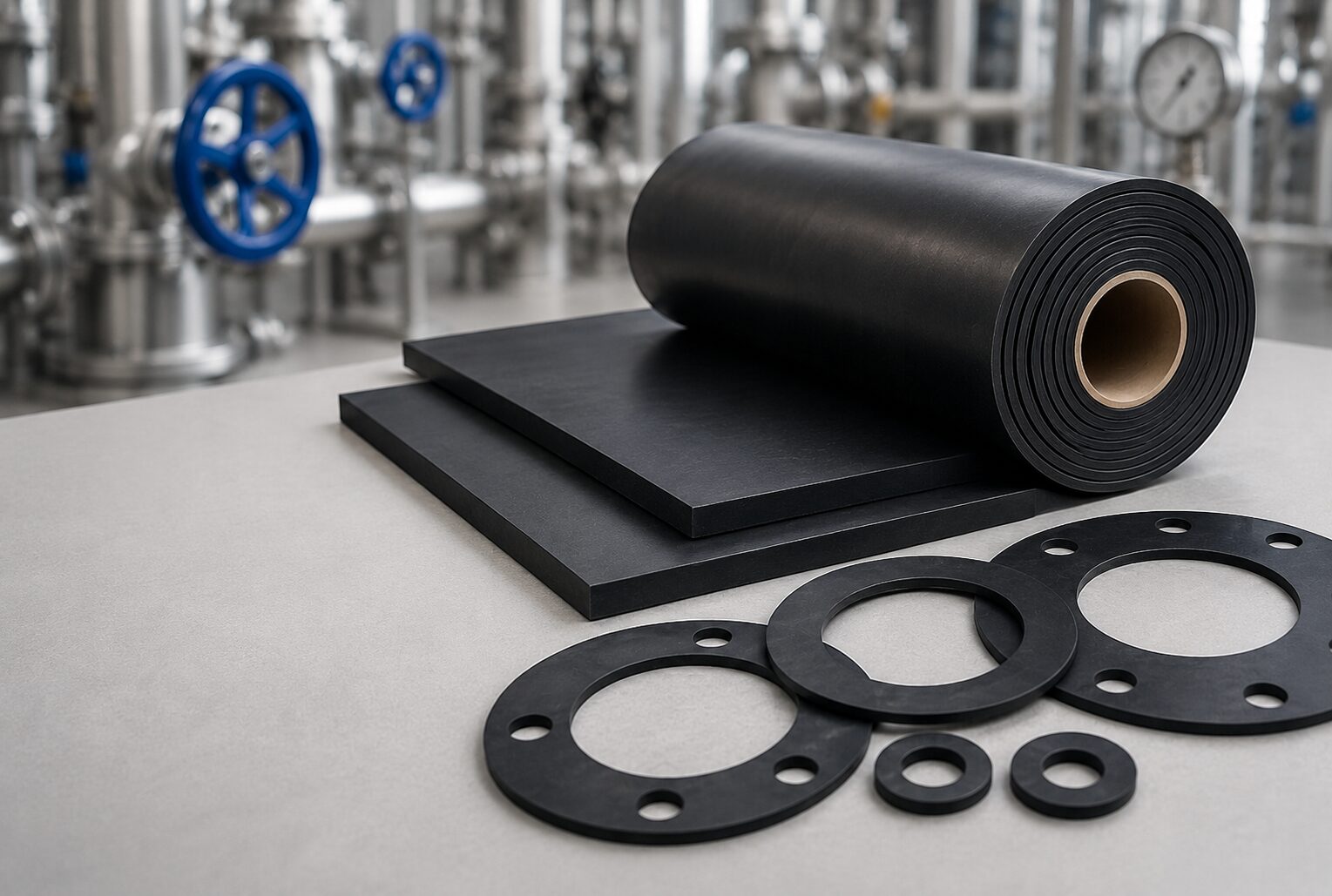
The material is used in various areas. Due to its slow crystallisation, CR is particularly used for seals in the automotive and other industries. Various seals made of this material are also used in air conditioning and medical technology. The shipping industry is also an important customer for this material, as it does not lose its function when it comes into contact with seawater.
We will be happy to answer your questions about whether CR is suitable as a sealing material for your purposes. Please contact our customer service, who will be happy to provide you with comprehensive advice.
FAQs About CR Gaskets:
What are CR seals?
What are the properties of CR seals?
What durability do CR seals offer?
Can CR seals also be equipped with self-adhesive?
Can CR also be purchased by the metre?
To the elastomer seals