


FKM seals
Heat-resistant, chemical-resistant, and suitable for the most demanding applications
FKM is a high-quality elastomer sealing material that is particularly notable for its outstanding resistance to high temperatures, oils, fuels, and numerous chemicals. In addition, FKM seals offer excellent resistance to aging, ozone, and weathering, as well as high abrasion resistance and low compression set. Because of these properties, FKM seals are used in demanding industrial applications—anywhere reliable sealing is required under high thermal and chemical stresses.
We at Rehm Dichtungen Ehlers GmbH process a wide variety of FKM sealing materials to produce custom flat and flange gaskets. From standard solutions to custom-made products based on your drawings, we manufacture your desired FKM gaskets precisely according to your requirements. Whether it’s a prototype, a small production run, or a large-scale production run—at Rehm Dichtungen, you benefit from our many years of experience and manufacturing processes tailored to every batch size and dimension.
What are FKM seals?
FKM is the abbreviation for fluorocarbon rubber compound, formerly also known as FPM. To distinguish between the terms, FKM is the international ISO designation for all fluoroelastomers, whereas FPM refers to the German DIN designation. This term encompasses an entire group of various synthetic polymer blends, all of which contain the monomer VDF (vinylidene difluoride). The material belongs to the M-group of rubbers, which are characterized by a saturated carbon backbone. The fluorocarbon rubber compound is marketed under the trade names Tecnoflon®, Dai-El®, and others. Viton® is one of the most important FKM brands and refers to a brand name for fluorocarbon elastomers coined by the U.S. company DuPont. In practice, Viton seals are also used as a synonym for required sealing solutions made of FKM. If seals made of Viton are specified in your drawings or bills of materials, we will be happy to assist you in selecting the appropriate FKM grade. The material (e.g.,FKM 75 Shore) is of very high quality and exhibits outstanding properties, making it an “all-around” elastomer. This is due to its combination of good heat and ozone resistance with resistance to a wide range of chemicals.
FKM Materials Available from Rehm Dichtungen
We have high-quality FKM qualities available in sheet and roll form.
CooperStandard
A-VF 75-00 FKM
The high-quality FKM grade A-VF 75-00 from the manufacturer CooperStandard has a fluorine content of approx. 66% and is therefore considered flame-retardant. The temperature range of the quality is between -15 °C and 250 °C, and for short periods even up to 275 °C, so that seals made of FKM are heat-resistant. In addition, the bisphenolic cross-linked elastomer is resistant to transformer oil and complies with Siemens standard SN 53145-1.
FKM A-VF 75-00 is PAH-free according to EU 1272/2013 and has REACH and RoHS conformity.
Technical data sheet:
Properties:
| Hardness [Shore A] | ISO 7619-1 | 75 +-5 |
| Density [g/cm³] | ISO 1183 | Approx. 1.96 +- 0.03 |
| Tensile strength [N/mm²] | ISO 37-S2 | 7 |
| Elongation at break [%] | ISO 37-S2 | 200 |
Other qualities
FKM 75 Shore
Technical data sheet:
Properties:
| Hardness [Shore A] | ISO 7619-1 | 75 +-5 |
| Density [g/cm³] | ISO 1183 | Approx. 1.84 |
| Tensile strength [N/mm²] | ISO 37-S2 | 7 |
| Elongation at break [%] | ISO 37-S2 | 230 |
The properties of FKM as a sealing material
Depending on the fluororubber compound, the material has different properties for different defined applications. The most important types include the copolymers VDF and HFP (hexafluoropropylene) and terpolymers VDF, HFP and TFE (tetrafluoroethylene).
Terpolymers are more resistant to chemicals than copolymers due to their higher fluorine content and are also more resistant to high temperatures. Copolymers, on the other hand, have advantages in compression set and show higher flexibility at low temperatures. Flat gaskets made of FKM have a significantly higher density than other elastomers such as flat gaskets made of EPDM or NBR. Compared to other sealing materials, a greater mass is required to achieve the required volume. In this context, stretching with fillers and plasticisers is not practical, which means that the manufacturing process is considered to be significantly more complicated.
The functionality of the FKM is mainly determined by the cross-linking system used, of which there are three important ones. Cross-linking with blocked diamines does not make the material resistant to steam. If the gasket material is bisphenolically cross-linked, products made from the material are more reliable in processing, but less resistant to some fuels. Peroxide cross-linking makes the material well resistant to hydrolysis and steam. In summary, it can be said that above all the copolymers used and the cross-linking system used have an influence on the operating temperature range of FKM seals.
Regarding the physical properties of FKM, it can be said that due to the stable fluorine-carbon bonds, a high penetration resistance is achieved, whereby the material insulates well electrically. Furthermore, the sealing material is impermeable to gas and very abrasion-resistant.
In terms of mechanical properties, flat gaskets made of FKM are very resistant and show low impact elasticity. The elongation at break of this material is >200%. Another decisive advantage in terms of mechanical properties relates to the low compression set, which means that the material deforms only very slightly under the effect of pressure.
In terms of thermal properties, the material proves to be heat-resistant in the temperature range up to 200°C or 250°C. Thus, they are listed by us as heat-resistant flat gaskets under gasket materials for special requirements.
Due to the high fluorine content, which is approx. 65 to 70%, flat gaskets made of FKM are considered flame-retardant.
Do you have any questions or would you like some free advice?
Feel free to contact us - we will help you! Our dedicated team is always on hand to answer your questions.

The advantages of FKM at a glance
Thanks to their outstanding properties, FKM flat gaskets are among the highest-performing elastomer seals in demanding industrial applications. Fluorocarbon rubber gaskets are superior to other sealing materials, particularly in environments where the gasket is subjected to multiple stresses simultaneously. The material is characterized in particular by its high temperature resistance, its excellent resistance to oils and fuels, and its high resistance to a wide variety of chemicals. The specific properties of FKM depend on the fluorine content in the material. The higher the fluorine content, the better the properties—though cold flexibility decreases accordingly.
High temperature resistance
FKM seals are particularly heat-resistant and can therefore be used over a wide temperature range. Depending on the specific material formulation, operating temperatures of approximately 200 °C and higher are possible. The operating temperature of a flat FKM gasket varies depending on the formulation, cross-linking system, operating duration, and medium. As a result, certain FKM grades can withstand even higher temperatures for short periods. These properties make them particularly suitable for applications in mechanical and plant engineering, engine manufacturing, power generation, and in thermally stressed piping and flange connections.
Excellent resistance to oil and fuel
In addition to the material’s outstanding temperature resistance, fluorocarbon rubber also exhibits excellent chemical resistance to a wide variety of oils and fuels. Depending on the blend ratio of the base material, FKM flat gaskets are suitable for contact with mineral oils, lubricating oils, gasoline, fuels, and numerous hydrocarbons. These excellent chemical and thermal resistance properties allow for use in applications where high temperatures and prolonged contact with oils or fuels occur simultaneously. For this reason, FKM flat gaskets are used in engines, transmissions, pumps, fuel systems, and industrial equipment.
High chemical resistance
In addition to its excellent resistance to oils and fuels, FKM offers excellent resistance to numerous aggressive media and chemical substances. However, the exact resistance depends on the specific FKM compound, the concentration of the medium, and the operating temperature. As a result, chemical-resistant FKM seals are suitable for numerous applications in chemical plant construction, process engineering, mechanical engineering, and the petrochemical industry.
Excellent resistance to ozone, UV radiation, and weathering
Fluorocarbon rubber also offers excellent resistance to ozone, UV radiation, and weathering. Compared to other elastomers, FKM seals age relatively slowly even under long-term stress, which is why FKM seals are considered durable and, above all, resistant to aging. Thanks to this property, FKM can be used in applications where the seal is exposed to high temperatures, oxygen, or fluctuating environmental conditions over extended periods. In the field of mechanical and plant engineering, this can contribute to longer maintenance intervals and greater operational reliability.
Good mechanical properties
In addition to their high resistance to temperature and various media, FKM seals offer good mechanical properties. Depending on the quality of the material, the most notable mechanical properties include high resistance to mechanical aging, good abrasion resistance, and excellent compression set characteristics. As a result, FKM is suitable not only for static flat gaskets but also, more generally, for demanding sealing solutions across a wide variety of applications.
The Limitations and Disadvantages of FKM
Despite their excellent resistance to temperature, oil, and chemicals, FKM flat gaskets are not the optimal solution for this application, as even the high-performance elastomer FKM has limited resistance and certain constraints. For example, the material is only suitable to a limited extent for applications involving hot water or steam. In particular, the continuously high temperatures of steam lead to a deterioration in the material properties of Viton flat gaskets.
Even in terms of chemical resistance, fluorocarbon rubber seals are not universally resistant to all media. Any flat seals made of FKM are not resistant to polar solvents, glycol-based brake fluids, and low-molecular-weight organic acids. FPM, particularly Viton®, is also incompatible with ketones and ester solutions. Furthermore, FKM seals are not resistant to hydrogen fluoride, ammonium compounds, and methanol.
Another disadvantage of this sealing material is its limited low-temperature flexibility; as temperatures drop, FKM flange gaskets become increasingly stiff and lose elasticity. For this reason, standard FKM gaskets should not be used in applications where ambient temperatures are very low or where temperatures fluctuate widely.
However, given the many positive properties and advantages of FKM, the material costs are also higher compared to other elastomers. Consequently, the use of FKM flat gaskets is economically viable only if the specific properties of the sealing material are actually required. If operating conditions—such as those involving media, temperatures, and mechanical stresses—are less demanding, less expensive elastomers may be technically sufficient.
Differentiation of FKM gaskets from EPDM gasket material
Seals made of FKM and EPDM are characterised by their resistance to polar media. Furthermore, both materials are resistant to UV light, ozone and weathering. Both sealing materials also have good insulating properties. However, differences can be found in the temperature range, fuel resistance and resistance to hot and water vapour. While EPDM gaskets are temperature resistant in a temperature range between -30 and +100°C and are resistant to hot and water vapour, FKM gaskets have heat resistance up to 200°C or 250°C and fuel resistance.
If the use of flat gaskets made of NBR is ruled out due to high operating temperatures and complex chemical requirements, flat gaskets made of FKM can be considered as the suitable alternative.
The way to your flat gasket made of FKM
The FKM qualities available from us and stocked as standard are subjected to a quality control at the beginning of the goods receipt process. Following approval, the gasket material is stored in the form of rolls and sheets at the appropriate storage location. Only then can we guarantee a consistently high quality, also with regard to the respective sealing material.
FKM is one of the sealing materials that can be processed using all of our manufacturing methods. The selection of the most suitable manufacturing method for your flat gaskets made from this material depends on the quantity, the desired contour, and the thickness of the material in question. Using the selected method, the unprocessed roll or sheet stock is then processed into your custom FKM flat gasket.
In addition, we can apply a self-adhesive film to the roll or sheet material in advance and then, using our manufacturing processes, transform it into your self-adhesive gaskets. Self-adhesive FKM gaskets serve exclusively as an assembly aid without altering the material properties. In addition to manufacturing flange and flat gaskets, we also offer unprocessed roll or sheet stock, as well as custom-cut material by the meter for your own further processing. Here, too, we can apply the self-adhesive backing to the material in advance.
After completion of the production and a renewed quality control, the flat or flange gaskets are packed and shipped to you.
Areas of application for FKM seals
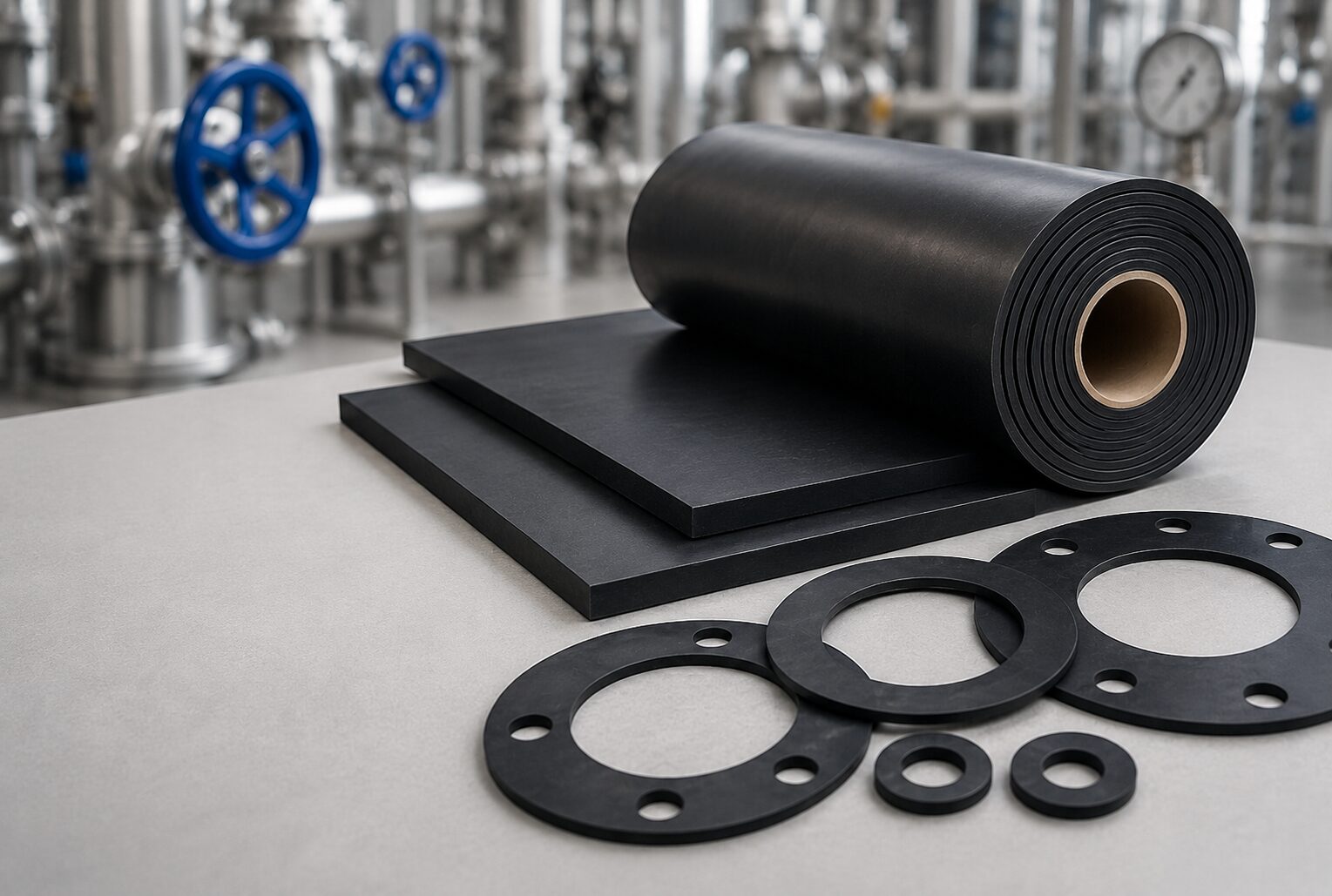
Due to their excellent resistance to oils, fuels, and a wide range of chemicals, FKM flat or flange seals are used wherever conventional sealing materials reach their limits. Especially when high temperatures, aggressive media, and demanding operating conditions are present, fluorocarbon rubber (Viton) seals are preferred over NBR and EPDM seals and are suitable for numerous industrial applications.
FKM flat gaskets are frequently used in the chemical and process industries to seal against aggressive or demanding media under high-temperature conditions.
Furthermore, custom-designed flat and flange gaskets made of FKM are well-established solutions in mechanical and plant engineering. This is particularly true for applications that must meet high thermal requirements and involve contact with lubricants, hydraulic oils, or other operating fluids.
The material’s excellent resistance to oil, mineral oil, and fuel makes it suitable for use in automotive and engine engineering. In general, FKM seals manufactured to specifications are a suitable solution for demanding sealing applications in industrial internal combustion engines and power units. This is particularly true in areas where there is constant contact with fuel.
Other areas of application for Viton seals that we are aware of include, for example, oil, gas, and power generation systems ; aerospace; and pump and valve technology. Thanks to their high temperature resistance and comparatively low gas permeability, they can also be used in vacuum applications.
Typical installation scenarios in the described application areas for flat and flanged gaskets include, for example, pumps, valves, piping, process plants, compressors, and fittings.
We will be happy to answer whether the material is also suitable for your purposes. Please contact our customer service and let us advise you.
FAQ on FKM Seals:
What are FKM seals?
What is the difference between FKM and Viton®?
What is the difference between FKM and FPM?
What resistance do FKM seals offer?
Can FKM gaskets also be equipped with self-adhesive?
Are FKM seals heat-resistant?
Are FKM seals oil-resistant?
Are FKM seals fuel-resistant?
When should FKM be used instead of EPDM?
Can FKM also be purchased by the metre?
Where are the data sheets on FKM?
To the elastomer seals