


EPDM gaskets
Versatile, weather-resistant, and durable
EPDM is a proven elastomer sealing material that is particularly characterized by its excellent resistance to ozone and UV radiation and is considered to be fundamentally weather-resistant. Due to these outstanding properties, EPDM seals are used wherever permanent elasticity, thermal stability, and reliability are required under demanding environmental conditions.
We at Rehm Dichtungen Ehlers GmbH process a wide variety of EPDM sealing materials into customized flat and flange gaskets. From standard solutions to custom-made products based on drawings, we manufacture your desired seals from EPDM. Whether you need prototypes, small or large series, we at Rehm Dichtungen have the right manufacturing process for your batch size and dimensions.
What is EPDM?
EPDM is the abbreviation for ethylene-propylene-diene(monomer) rubber and belongs to the M-group of rubbers. Within the framework of the classification of rubbers, seals made of this sealing material are thus assigned to the non-polar saturated rubbers. The material is a high-quality, rubber-elastic, synthetic elastomer made of very long, saturated and highly stable molecular chains, the macromolecules ethylene, propylene and diene. Other trade names are, for example, BUNA-AP®, KELTAN® and NORDEL®. Due to the diverse properties and resistances of EPDM, the sealing material can be used in many areas of application.
Table of Contents
- Available EPDM materials
- The advantages and material properties
- The properties of EPDM as a sealing material
- The limits and disadvantages of EPDM
- Differentiation of EPDM from other sealing materials
- EPDM resistances at a glance
- Production of EPDM as a sealing material
- The way to your EPDM flat gasket
- Application areas of EPDM gaskets
- FAQs about EPDM
EPDM materials available from Rehm Seals
Depending on the intended use or area of application, we have a wide range of different EPDM sealing materials available as the base material for our EPDM seals. These materials differ not only in color but also in terms of their chemical, thermal, and mechanical properties.
In addition to our standard qualities, we also manufacture EPDM seals from EPDM sealing materials for special requirements, for which the relevant conformities and approvals are available. This means we can produce EPDM seals with a fire protection classification or for contact with drinking water.
We source most of our EPDM sealing material from the Austrian manufacturer Semperit. We are their largest distributor in the elastomer sheet sector. Thanks to Semperit, as a European manufacturer, we can supply you with high-quality EPDM seals of consistent quality that are characterized by their durability and precision. Sustainability and good traceability of materials are also hallmarks of the company.
All Semperit EPDM grades are free of halogens and conflict materials. They also comply with REACH and RoHS. In addition to Semperit grades, the material is also available in imported quality and Holcim quality. In the field offoamed materialsin combination with EPDM components, we carrycellular rubberandfoam rubber.
Semperit: Standard qualities
E 4580
EPDM E 4580 is sulphur cross-linked, suitable for use in various automotive parts and complies with various automotive standards - such as VW2.8.1G50.
Technical data sheet:
Properties:
| Hardness [Shore A] | ISO 7619-1 | 50 +-5 |
| Density [g/cm³] | ISO 1183 | Approx. 1.05 |
| Tensile strength [N/mm²] | ISO 37-S2 | 8 |
| Elongation at break [%] | ISO 37-S2 | 500 |
Approvals and certifications:
- Complies with various automotive standards (VW2.8.1 G50)
- Corresponds to WDK guideline 2201
- SVHC-free
E 9566
The sulphur-cured EPDM E9566 is our standard quality and also meets various automotive standards. The material is also characterised by a very good price-performance ratio.
Technical data sheet:
Properties:
| Hardness [Shore A] | ISO 7619-1 | 70 +-5 |
| Density [g/cm³] | ISO 1183 | Approx. 1.30 |
| Tensile strength [N/mm²] | ISO 37-S2 | 7 |
| Elongation at break [%] | ISO 37-S2 | 250 |
Approvals and certifications:
- Complies with various automotive standards (VW2.8.1 G70)
- Corresponds to WDK guideline 2201
- SVHC-free
E 9614
EPDM E 9614 is a favourable peroxide nourished quality. It retains its physical values for a short time even at high temperatures up to +140 °C and is therefore used in the automotive industry.
Technical data sheet:
E9614 EPDM 70 Shore peroxide cross-linked
Properties:
| Hardness [Shore A] | ISO 7619-1 | 70 +-5 |
| Density [g/cm³] | ISO 1183 | Approx. 1.22 |
| Tensile strength [N/mm²] | ISO 37-S2 | 9 |
| Elongation at break [%] | ISO 37-S2 | 200 |
Approvals and certifications:
- slight decrease in physical values at high temperatures
- Complies with various automotive standards (VW2.8.1 G70)
- Corresponds to WDK guideline 2201
- SVHC-free
E 9575
The material EPDM E9575 is a high-grade, sulphur-cured elastomer with an excellent price-performance ratio. It is characterized by high resistance to weathering and ozone and is ideal for applications in the temperature range from -40°C to +100°C. In addition, the material E9575 is subject to the total limit value of 50 mg/kg in accordance with AfPS GS 2019:01 PAH category 3b.
Technical data sheet:
Properties:
| Hardness [Shore A] | ISO 7619-1 | 80 +-5 |
| Density [g/cm³] | ISO 1183 | Approx. 1.30 |
| Tensile strength [N/mm²] | ISO 37-S2 | 5 |
| Elongation at break [%] | ISO 37-S2 | 200 |
Approvals and certifications:
- Corresponds to WDK guideline 2201
- SVHC-free
Semperit: Special qualities
E628
EPDM E628 is a peroxide-cured elastomer with excellent resistance to weathering and ozone, ideal for applications at temperatures from -50°C to +150°C. The material offers high tensile strength and resistance to acids and strong bases.
Technical data sheet:
Properties:
| Hardness [Shore A] | ISO 7619-1 | 70 +-5 |
| Density [g/cm³] | ISO 1183 | Approx. 1.12 |
| Tensile strength [N/mm²] | ISO 37-S2 | 11 |
| Elongation at break [%] | ISO 37-S2 | 250 |
Approvals and certifications:
- certified according to ACS
- Corresponds to WDK guideline 2201
- SVHC-free
E2514
EPDM E2514 is the successor of E628, suitable for contact with drinking water and certified according to the ELL and W270 standards as well as the British WRAS.
Technical data sheet:
Properties:
| Hardness [Shore A] | ISO 7619-1 | 67 +-5 |
| Density [g/cm³] | ISO 1183 | Approx. 1.09 |
| Tensile strength [N/mm²] | ISO 37-S2 | 9 |
| Elongation at break [%] | ISO 37-S2 | 200 |
Approvals and certifications:
- Certified according to elastomer guideline (ELL+W270) for cold and hot water
- certified according to WRAS
- certified according to ACS
- Complies with DIN EN 681-1
- Corresponds to WDK guideline 2201
- SVHC-free
E633
Aquastar EPDM E633 is a replacement for E2514 and E628 and complies with the new KTW-BWGL regulation. This EPDM is approved for contact with cold and hot water (up to 60°C) in risk group P2 and is also suitable for pipe seals in accordance with EN681-1.
Technical data sheet:
Properties:
| Hardness [Shore A] | ISO 7619-1 | 70 +-5 |
| Density [g/cm³] | ISO 1183 | Approx. 1.11 |
| Tensile strength [N/mm²] | ISO 37-S2 | 11 |
| Elongation at break [%] | ISO 37-S2 | 300 |
Approvals and certifications:
- certified according to KTW-BWGL for sealing joints (P2) with cold and hot water (up to 60°C)
- Complies with DIN EN 681-1
- Corresponds to WDK guideline 2201
- SVHC-free
Fire protection materials
E 2441
This EPDM E2441 has the fire protection classification according to DIN EN 45545 for material with a thickness of 2 to 10 millimetres.
Technical data sheet:
E2441 EPDM 60 Shore Fire Protection
Properties:
| Hardness [Shore A] | ISO 7619-1 | 60 +-5 |
| Density [g/cm³] | ISO 1183 | Approx. 1.12 |
| Tensile strength [N/mm²] | ISO 37-S2 | 7 |
| Elongation at break [%] | ISO 37-S2 | 300 |
| Abrasion [mm³] | ISO 4649 | 350 |
| Tear resistance [N/mm] | ISO 34-1 | 6 |
| Fire behaviour | R22/HL2 R23/HL2 |
EN 45545-2 |
Approvals and certifications:
- Fire protection classification for 2 to 10 mm thickness according to DIN EN 45545 Part 2: 2016-02 for requirement sets R22/R23
- 2-5 mm: Type class HL2
- 6-10mm: Type class HL3
- Meets vehicle fire classification according to EU Directive 95/28/EC and US FMVSS 302
- Corresponds to WDK guideline 2201
- SVHC-free
Import qualities
EPDM/SBR 50 Shore
Technical data sheet:
Properties:
| Hardness [Shore A] | 50 +-10 |
| Density [g/cm³] | Approx. 1.35 |
| Tensile strength [N/mm²] | 4 |
| Elongation at break [%] | 250 |
EPDM/SBR 65 Shore
Technical data sheet:
Properties:
| Hardness [Shore A] | 65 +-10 |
| Density [g/cm³] | Approx. 1.4 |
| Tensile strength [N/mm²] | 4 |
| Elongation at break [%] | 250 |
EPDM/SBR 80 Shore
Technical data sheet:
Properties:
| Hardness [Shore A] | 80 +-10 |
| Density [g/cm³] | Approx. 1.4 |
| Tensile strength [N/mm²] | 4 |
| Elongation at break [%] | 200 |
EPDM/SBR 65 Shore with insert
Technical data sheet:
Properties:
| Hardness [Shore A] | 65 +-10 |
| Density [g/cm³] | Approx. 1.4 |
| Tensile strength [N/mm²] | 4 |
| Elongation at break [%] | 250 |
EPDM/SBR light 65 Shore
Technical data sheet:
Properties:
| Hardness [Shore A] | 65 +-10 |
| Density [g/cm³] | Approx. 1.5 |
| Tensile strength [N/mm²] | 5 |
| Elongation at break [%] | 300 |
Newly developed EPDM qualities
E9566
This material corresponds to the sulphur-cured EPDM E9566, but is PAH-free. It therefore does not contain any polycyclic aromatic hydrocarbons of concern.
Technical data sheet:
Properties:
| Hardness [Shore A] | ISO 7619-1 | 70 +-5 |
| Density [g/cm³] | ISO 1183 | Approx. 1.30 |
| Tensile strength [N/mm²] | ISO 37-S2 | 6 |
| Elongation at break [%] | ISO 37-S2 | 250 |
Approvals and certifications:
- PAH free
- Complies with various automotive standards (VW2.8.1 G70)
- Corresponds to WDK guideline 2201
- SVHC-free
E 563
EPDM E563 is a special compound for films from 0.3 mm. The sulphur-cured sealing material is highly resistant to weathering and ozone and also has good resistance to strong bases;
Technical data sheet:
Properties:
| Hardness [Shore A] | ISO 7619-1 | 75 +-5 |
| Density [g/cm³] | ISO 1183-1 | Approx. 1.19 |
| Tensile strength [N/mm²] | ISO 37-S2 | 10 |
| Elongation at break [%] | ISO 37-S2 | 250 |
CooperStandard
A-KF 25-00 EPDM
This EPDM is sulphur cross-linked. It complies with DBL 557.10.
Technical data sheet:
Properties:
| Hardness [Shore A] | ISO 7619-1 / 3s | 25 +- 5 |
| Density [g/cm³] | DIN EN ISO 1183 / ISO 2781 | 1,00 +- 0,02 |
| Tensile strength [N/mm²] | ISO 37 | > 3,5 |
| Elongation at break [%] | ISO 37 | > 400 |
Approvals and certifications:
- Rebound resilience > 50%
- Very high elongation
- corresponds to DBL 5571.10
- PAH free
A-KJ 50-00 EPDM
This EPDM is peroxide cross-linked and can be used up to 150 °C for short periods.
Technical data sheet:
Properties:
| Hardness [Shore A] | ISO 7619-1 / 3s | 50 +- 5 |
| Density [g/cm³] | DIN EN ISO 1183 / ISO 2781 | 1,05 +- 0,02 |
| Tensile strength [N/mm²] | ISO 37 | > 12 |
| Elongation at break [%] | ISO 37 | > 350 |
Approvals and certifications:
- PAH free
- corresponds to VW 2.8.1 G50
- Makrolon and Plexiglas -resistant
- Can be used for short periods up to 150 degrees Celsius
Other elastomers
EPDM 30 Shore
EPDM 30 Shore is very resistant to ozone, weathering, acids and basic alkalis
Technical data sheet:
Properties:
| Hardness [Shore A] | 30 +-5 | |
| Density [g/cm³] | ASTM D397 | Approx. 1.06 +- 0.03 |
| Tensile strength [N/mm²] | ASTM D412 | >10 |
| Elongation at break [%] | ASTM D412 | 600 |
EPDM 55 Shore Heat
Technical data sheet:
Properties:
| Hardness [Shore A] | 55 +-5 | |
| Density [g/cm³] | ASTM D397 | Approx. 1.15 +- 0.03 |
| Tensile strength [N/mm²] | ASTM D412 | >5 |
| Elongation at break [%] | ASTM D412 | 250 |
EPDM 70 Shore
Technical data sheet:
Properties:
| Hardness [Shore A] | 70 +-5 | |
| Density [g/cm³] | UNE 53526 | Approx. 1.23 |
| Tensile strength [N/mm²] | ISO 37 | >9 |
| Elongation at break [%] | ISO 37 | 200 |
The advantages and material properties of EPDM at a glance
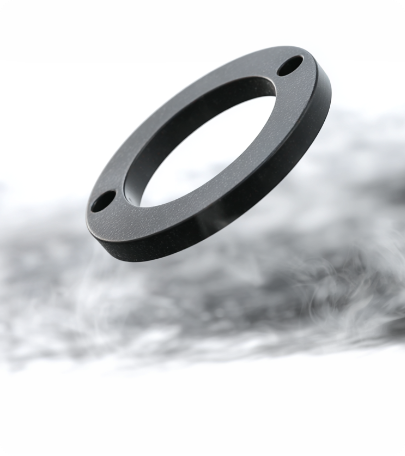
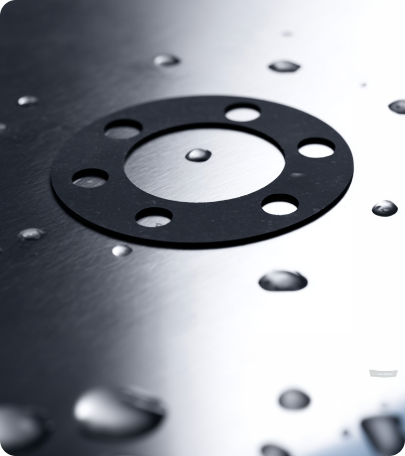
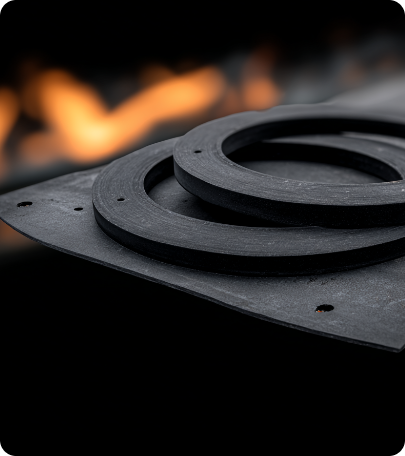
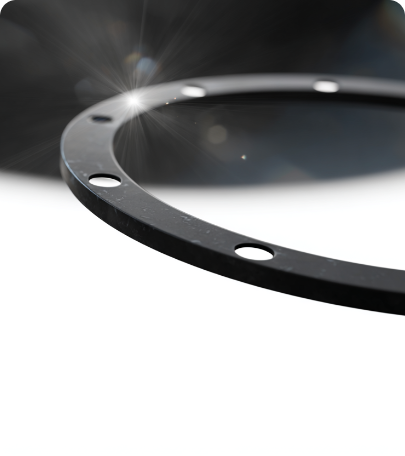
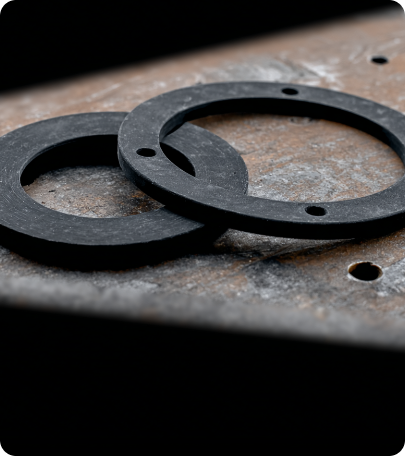
Seals and sheets made of this material are characterised by the following advantages:
The properties of EPDM as a sealing material
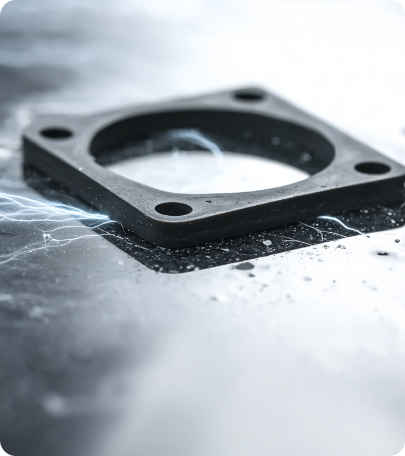
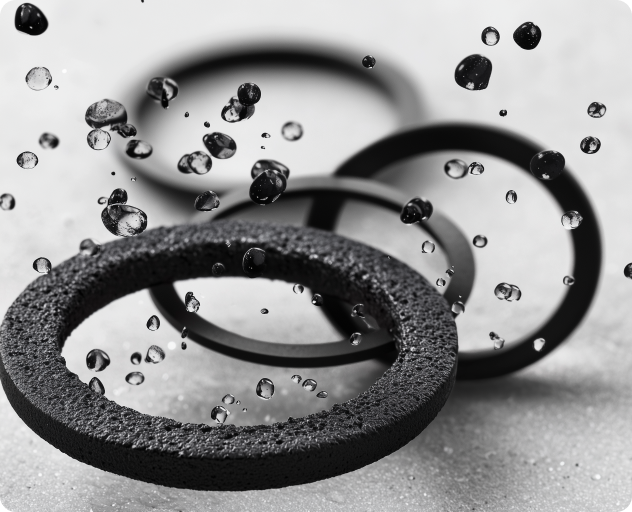
Even though EPDM is available in different mixing ratios (mainly due to the ethylene and diene content), the material has a number of fundamentally identical properties. Based on its saturated main chain, this synthetic rubber is characterized by very good aging resistance and high resistance to ozone, UV radiation, heat, and oxygen. In addition, seals and flat gaskets made of EPDM are heat and weather resistant. The material is also resistant to hot steam, hot water, and polar media, including diluted acids and alkalis, alcohols, ketones, salt solutions, and silicone oils. Finally, its high electrical resistance is also worth mentioning.
The various mechanical properties and high long-term stability of the elastomer make the material a versatile sealing material for a wide range of industrial applications. EPDM seals have high elasticity due to their typically high elongation at break, which is why they reliably adapt to the surfaces to be sealed even under dynamic or thermal stresses. Compared to other elastomers, flat seals made of EPDM have a pronounced resilience (compression set). This means that EPDM seals exhibit low permanent deformation after continuous compression. Another mechanical property of EPDM is its variable degree of hardness, which allows it to be used for almost any application. The lower the Shore hardness (25-50 Shore A) of the material, the more flexible and adaptable the flat gasket produced. High degrees of hardness (80 Shore A) are particularly suitable for higher mechanical loads and resistant pressure stresses. The temperature range for EPDM seals varies depending on the material quality used. However, a rough range of approximately -40 °C to +120 °C can generally be specified. This material therefore offers excellent thermal properties for a wide variety of applications.
EPDM is usually sulphur cross-linked, but also exists as a peroxide cross-linked material. Peroxide cross-linking achieves a significantly higher temperature resistance. A higher ethylene content improves low-temperature flexibility and elasticity. A higher proportion of diene ensures a higher cross-linking speed and density as well as strength.
One disadvantage of this material is its instability when exposed to non-polar media such as fats, mineral oils, and fuels.
The limits and disadvantages of EPDM
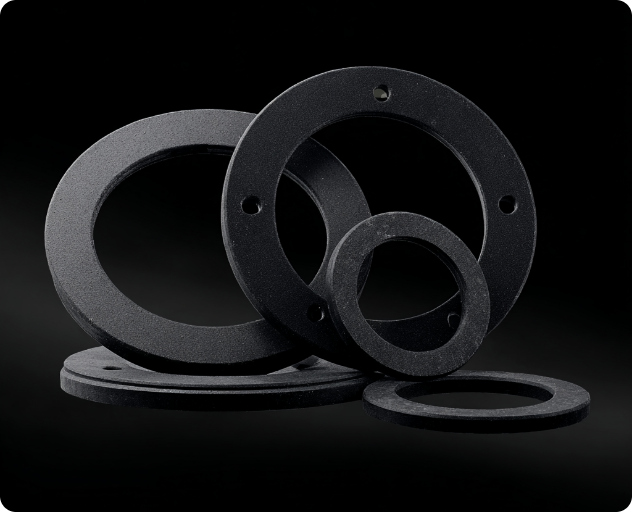
When using EPDM seals, however, the limitations and disadvantages of the elastomer should also be taken into account. Flat or flange seals made of EPDM are not resistant to various chemical substances, such as fuels, lubricants, or solvents. Aggressive chemicals and cleaning agents in particular can damage EPDM seals and thus impair their function. NBR is a suitable sealing material for oil-resistant seals. In addition, temperature restrictions apply to EPDM seals. The temperature range of the material is approximately between -40°C and +140°C. However, the exact temperature range depends on the specific composition of the material. The exact temperature range is specified in the technical data sheet for the respective EPDM quality.
For higher temperature requirements, FKM or silicone should be considered in the elastomer range, as EPDM seals lose their elasticity at higher temperatures and the material becomes brittle. Another disadvantage of this material is its high gas permeability, which means that EPDM seals are not recommended for sealing gases such as oxygen or nitrogen. Finally, the material is not suitable for applications with high mechanical loads, as it has lower abrasion and tear resistance compared to other elastomers.
Do you have any questions or would you like some free advice?
Feel free to contact us - we will help you! Our dedicated team is always on hand to answer your questions.

Differentiation of EPDM from other sealing materials
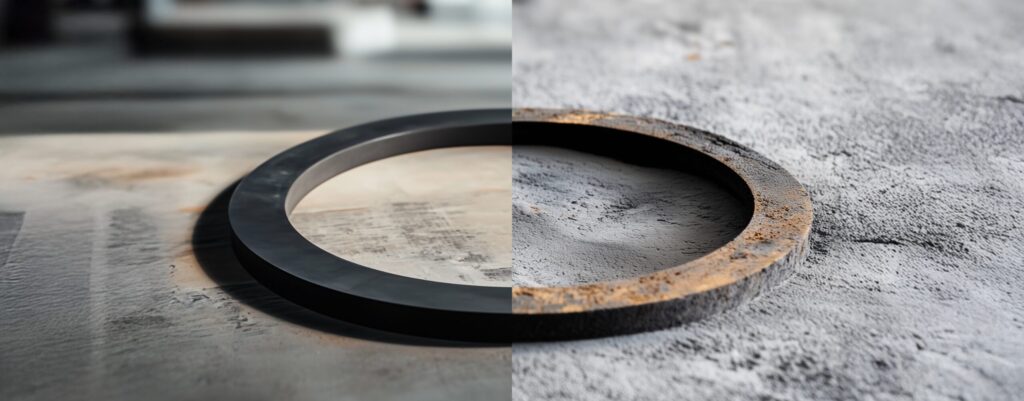
The sealing materials EPDM and NBR are synthetic rubbers, but they have some differences to each other. While EPDM is produced by polymerizing ethylene and propylene, NBR is produced from nitriles and butadiene. Accordingly, the two materials differ in terms of their resistances. Among other things, seals made of EPDM have good chemical resistance to polar media and organic and inorganic acids and bases. In addition, the gasket material is resistant to UV light and ozone and is therefore considered to be resistant to weathering and aging. The resistance to weathering and aging represents a major difference from NBR, as nitrile butadiene rubber does not have this resistance. However, NBR seals stand out primarily because of their good resistance to fuels, oils and solvents. Another difference between the two materials lies in the temperature range in which they can be used. Flat or flange gaskets made of EPDM can be used in a wider temperature range than gaskets made of NBR.
There are also significant differences compared to FKM rubber. Fluororubber gaskets have a higher temperature range than EPDM gaskets. The chemical resistance of Viton and FKM should also be emphasized as a distinguishing feature. While EPDM is not resistant to oils, greases and fuels and therefore has limitations when used in mechanical engineering, FKM has excellent resistance to the aforementioned media. However, when selecting a suitable sealing material, the better resistance to ageing and the lower price of EPDM compared to FKM should not be neglected.
In terms of temperature range and low-temperature flexibility, silicone flat gaskets have a thermal advantage over EPDM gaskets, as they can be used in a wider temperature range.
EPDM resistances at a glance
| Material designation | Ozone and weather resistance | Oil and petrol resistance | Acid resistance | Strong bases | Wear resistance |
|---|---|---|---|---|---|
| Semperit E2514 | Well resistant | not durable | constant | constant | conditionally stable |
| Semperit E628 | Well resistant | not durable | constant | constant | conditionally stable |
| Semperit E2441 | Well resistant | not durable | constant | Well resistant | conditionally stable |
| Semperit E9575 | Well resistant | not durable | constant | Well resistant | conditionally stable |
| Semperit E9614 | Well resistant | not durable | constant | Well resistant | conditionally stable |
| Semperit E9566 | Well resistant | not durable | constant | Well resistant | conditionally stable |
| Semperit E4580 | Well resistant | not durable | constant | Well resistant | conditionally stable |
| Semperit E9568 | Well resistant | not durable | constant | Well resistant | Not suitable |
| Cooper Standard A-KF 25-00 | Well resistant | not durable | constant | constant | conditionally stable |
| Cooper Standard A-KJ 50-00 | Well resistant | not durable | constant | constant | conditionally stable |
Production of EPDM as a sealing material
The synthetic rubber EPDM consists of the three main components ethylene, propylene and diene. The mixing ratio of the three components varies depending on the formulation and influences the properties of the EPDM. As a result, there are different EPDM variants, making it a versatile material for a wide range of industrial applications. For the production of EPDM/SBR, SBR (styrene-butadiene rubber) is added to the mixture.
The production of EPDM begins with the polymerization of the three main components, which are chemically combined in this step using a catalyst. In the next step, additional substances, such as fillers, are added to the resulting raw polymer. The final stage of the manufacturing process is vulcanization, in which "loose" polymer chains are turned into solid chemical bonds between the polymer chains. Sulphur or peroxides can be used as vulcanization agents. The choice of agent has an influence on the temperature resistance of the EPDM quality.

The way to your EPDM flat gasket
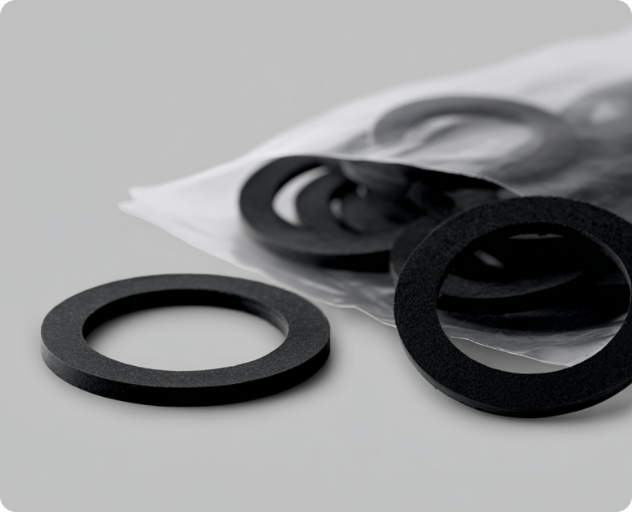
At Rehm Dichtungen Ehlers GmbH, you can obtain your customized flat or flange gaskets made of EPDM, as well as EPDM strips, directly from the gasket manufacturer. We manufacture almost all dimensions and contours and can flexibly adapt to your desired batch size.
The qualities presented and available at our company are first subjected to a quality control at goods receipt. Only then, after approval, is the sealing material stored in the form of rolls and sheets at the respective storage location. This enables us to guarantee a consistently high quality, also with regard to the respective sealing material.
EPDM belongs to the group of gasket materials that can be processed in all our manufacturing processes. The selection of the most suitable production process for your EPDM flat gaskets depends on the number of pieces, the respective contour and the thickness of the material. The unprocessed roll or sheet material is then processed into the individual EPDM flat gasket using the selected process.
It is also possible to apply a self-adhesive film to the roll or sheet material in advance and then process it into your self-adhesive EPDM gaskets using the manufacturing process. Self-adhesive gaskets serve exclusively as an assembly aid without changing the properties of EPDM. In addition to the production of flange and flat gaskets, we also offer unprocessed rolls or sheets as well as cut-to-size EPDM material by the meter for further processing. It is also possible for us to apply a self-adhesive finish to the material.
After completion of the production and a renewed quality control, the seals are packed and shipped to you.
Application areas of EPDM gaskets
EPDM is used as a sealing material in many areas and industries. The elastomer is available in rolls and sheets. As a gasket manufacturer, we primarily cut these into flat gaskets, strips and blanks as required.
For example, in the construction industry and in outdoor applications, seals made from this material are used as pipe seals for drinking water and wastewater systems, as EPDM is weather- and ozone-resistant.
EPDM is ideal as a sealing material for various water-carrying building elements, such as outdoor water pipes, seals in water taps, or door seals. Flat and flange seals are therefore also suitable for use in water treatment plants to prevent leaks and seepage. The black elastomer is also well suited as a substrate for green roofs, as it is root-resistant. In the automotive industry, EPDM seals and other components made from this material are increasingly being used in safety-related parts of automotive brakes. Another application we are aware of is the sealing of radiator, heating, and ventilation hoses. Due to their excellent aging resistance, EPDM seals are also used in various agricultural machines such as combine harvesters and crop strippers. In the field of mechanical and plant engineering, our EPDM seals are used for a wide variety of applications, as the versatility of the material meets the dynamic requirements. Due to their excellent resistance to hot and cold water in combination with KTW approval (E633), our products are a reliable component in the sanitary, heating, and drinking water industries.
Other technical rubber products include the area around the topic of conveyor belts, which is also covered in depth under the item conveyor belts. Finally, we also stock EPDM materials with approvals for contact with drinking water and foodstuffs.
As a sealing material, the material offers a diverse range of applications and performs excellently, providing reliable protection.
We will be happy to answer whether the elastomer is also suitable for your purposes. Please contact our customer service, who will be happy to provide you with comprehensive advice.
Frequently asked questions:
Are EPDM seals suitable for contact with drinking water?
Can EPDM seals be used as fire protection seals?
When should EPDM seals be used?
What are EPDM seals?
What are the properties of EPDM gaskets?
What resistance do EPDM seals offer?
Can EPDM gaskets also be equipped with self-adhesive?
Are EPDM seals temperature resistant?
Are EPDM seals oil resistant?
Can EPDM also be purchased by the metre?
Where are the EPDM data sheets located?
To the elastomer seals